

What Is A Sinus Lift?
The maxillary sinuses are located behind the cheeks and above the upper teeth, serving as empty spaces filled with air. Some of the roots of the upper teeth extend into these sinuses, with only a thin bone wall separating them from the mouth. Dental implants require stable bone for success, and if the sinus wall is too thin, placing implants becomes impossible.
The quality and quantity of jawbone are crucial for the success of dental implants. If bone loss has occurred, a sinus augmentation can be performed to raise the sinus floor and promote new bone formation. This procedure is common for patients with bone loss in the upper jaw, aiming to grow bone in the maxillary sinus floor above the gum line. By strengthening and growing bone in this area, dental implants can be securely placed and anchored in the newly formed bone, ensuring their longevity and success.
Am I eligible for a sinus lift?
A sinus lift may be required if:
- have multiple missing teeth in the posterior region of your jaw.
- have a substantial amount of bone loss in the posterior region of your jaw.
- have congenitally missing teeth or teeth lost due to a medical condition.
- have lost most of your upper teeth but need assistance for dental implant placement.
What Is The Process For This Surgery?
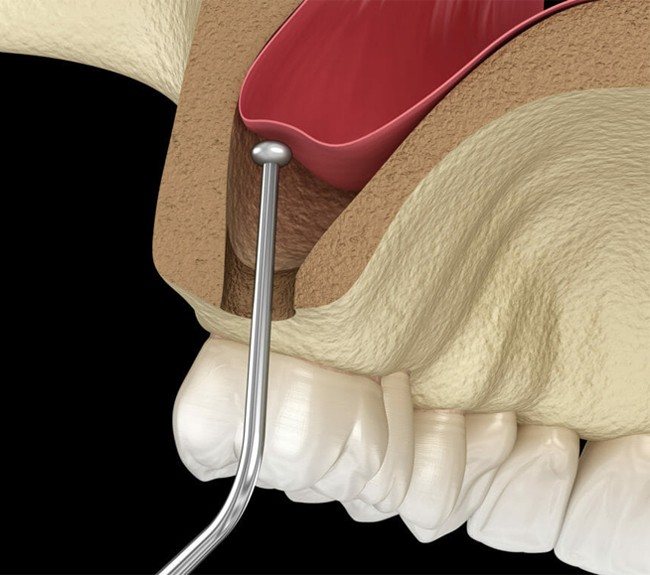
The most common sinus augmentation procedure involves creating a small incision in the premolar or molar region to access the jawbone. A small opening is then made in the bone to lift the sinus membrane. The space is filled with bone grafting material, which can be sourced from the patient's own body, a cadaver, or synthetic materials. The incision is closed with stitches and the healing process begins. After a few months, the bone integrates with the jaw, allowing for the placement of dental implants in the new sinus bone.
If there is sufficient bone available between the upper jaw ridge and the sinus, sinus augmentation and implant placement can be done simultaneously. If there is not enough bone, the sinus augmentation must be completed first, allowing time for the graft to mature before implants can be placed. This procedure has enabled many patients to receive dental implants instead of having to rely on loose dentures.
Innovative Dental Specialists typically performs sinus augmentations in-office under local anesthesia, although some patients may opt for oral or intravenous sedation.

New Patients Appointments Welcome!
